

Office Space in Raipur: 8 Things Businesses Should Check Before Finalising One
Avinash Group , 2026-09-18
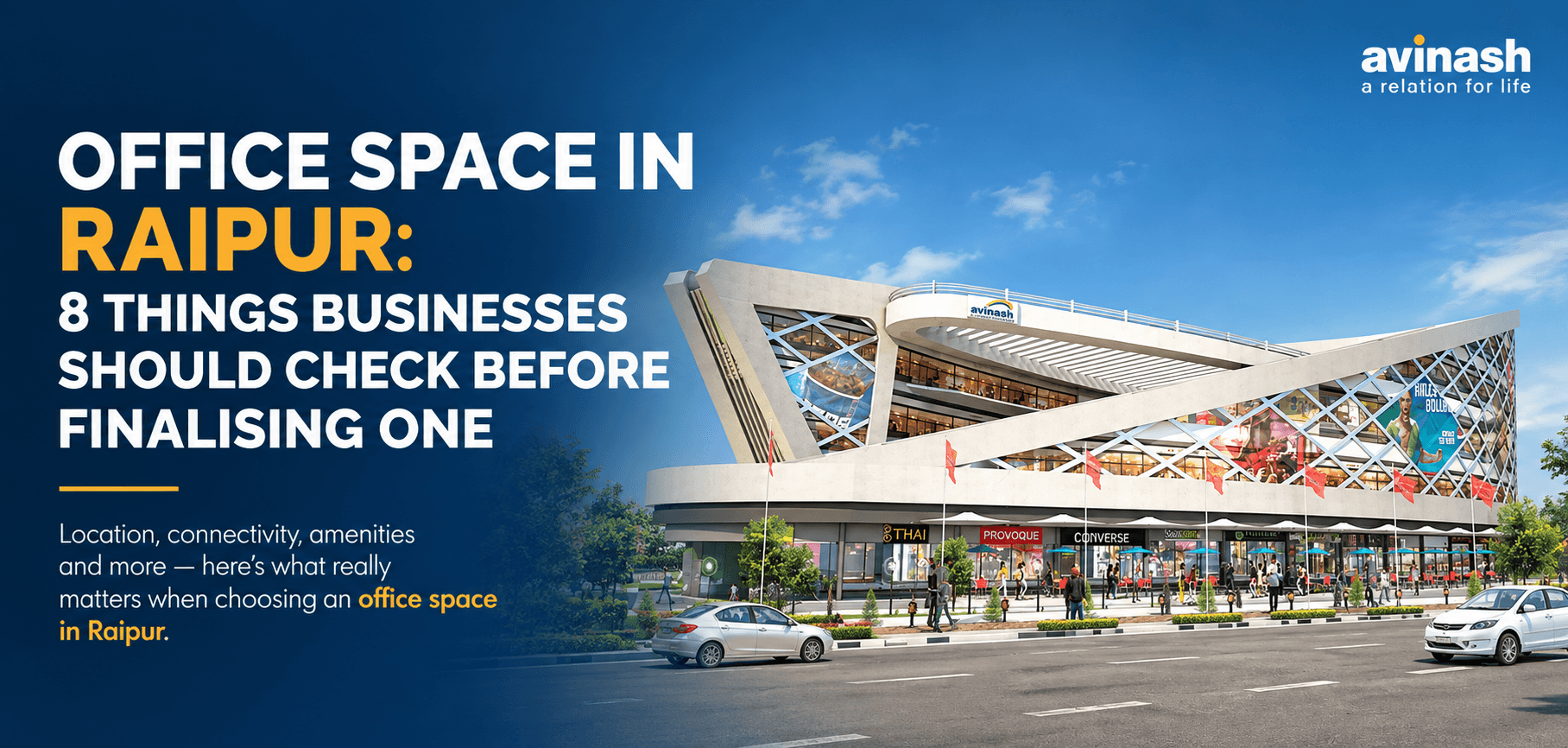
Picture a growing CA practice finally moving out of a converted flat and into a proper office. The unit looks sharp on a quiet Sunday site visit. Then Monday arrives. Clients circle the block looking for parking, the power backup only runs the lights, and the area printed in the brochure fits far fewer desks than anyone planned for.
None of this is unusual. Most office regrets trace back to questions nobody asked before the agreement was signed.
Before you finalise office space in Raipur, check eight things: the project's RERA registration and title papers, the real carpet area, how well the location works for your staff and clients, approval for your type of business, parking and access, building services, the full cost of occupancy, and the developer's track record. Here's how to tackle each one.
1. Check RERA Registration Before Booking Any Commercial Space in Raipur
Start with the paperwork, because everything else can be negotiated and this can't. Most commercial projects sold while under construction must be registered with the Chhattisgarh Real Estate Regulatory Authority (CG RERA) under the Real Estate (Regulation and Development) Act, 2016.
You don't need a lawyer to do the first check. Go to the CG RERA portal, search using the registration number printed on the brochure, and look at:
- The promoter's name, to make sure it matches the company you're actually dealing with.
- The approved plans, and whether the unit sizes you've been shown line up with them.
- The declared completion date, and whether it has already been extended.
- The quarterly progress updates, which registered developers are required to post.
For a ready building, ask for the occupancy certificate and copies of the title documents. A lawyer's title search costs very little compared with what's at stake.
One rule every buyer should know: under Section 13 of the RERA Act, 2016, a developer cannot accept more than 10% of the unit cost as an advance before a written agreement for sale is registered. If someone pushes for a larger booking amount on a handshake, that tells you what you need to know.
2. Know Exactly How Much Space You Are Paying For
Commercial brochures often quote super built-up area. That figure adds your share of lobbies, corridors, lift wells, and staircases to the space inside your door. It's a legitimate number, but it isn't the number your desks will sit on.
Carpet area is. Section 2(k) of the RERA Act, 2016 defines it as the net usable floor area of a unit, excluding external walls, service shafts, and exclusive balconies, but including internal partition walls. Registered projects have to disclose it, so ask for it in writing.
Two units with similar super built-up sizes can hold very different numbers of workstations, depending on how much common area is loaded onto each and where the columns fall.
A simple habit fixes most of this. Compare carpet area to carpet area when you shortlist, and ask an interior designer to do a rough seating layout on the actual floor plan before you commit.
3. Pick the Right Location for Your Office Space in Raipur
Raipur offers businesses two quite different choices. The established city belt along G.E. Road and the older commercial areas is where much of the city's existing business activity already sits. Naya Raipur (officially Nava Raipur Atal Nagar), the planned capital region, offers organised sectors, wider roads and newer buildings, but it sits further from the old centre.
Real distances make the trade-off clearer than any brochure line. Avinash One, on the city side near Magneto The Mall, lists the airport at 9.7 km and the railway station at 9.2 km. Avinash Times Square in Naya Raipur lists the airport at 12.3 km and the new railway station at 5.9 km. Neither is "better". They simply suit different businesses.
So before you fall for a building, answer these honestly:
- Where do most of your employees live, and what will the daily commute look like for them?
- Do clients walk in regularly, or do you mostly meet them online or at their offices?
- Does your business depend on street visibility, or does it just need a professional address?
- How developed is the immediate neighbourhood today, as opposed to on the master plan?
That last question deserves a weekday visit. Planned areas take time to fill in, so check whether there are places to eat nearby and how easily a cab or auto reaches the gate.
4. Confirm the Unit Is Approved for Your Type of Business
An office unit isn't automatically suitable for every business. A diagnostic clinic, a coaching institute, a bank branch, and a software team each have different needs around footfall, fire safety, signage, and even how much weight the floor can carry.
Before you finalise, check that:
- The building's sanctioned use covers your activity, whether that's office, retail or something institutional.
- A valid fire NOC is in place for the building.
- You're allowed a signboard on the façade, and exactly where it can go.
- Your regulator or licensing body accepts the premises, if you run a clinic, bank, school or similar regulated business.
Fixing this after the fit-out is painful and expensive. Fixing it before you sign usually takes one email.
5. Test Parking, Lifts and Visitor Access on a Working Day
Parking is one of the most common complaints in commercial buildings, and it almost never shows up on a quiet site visit. Go back at a busy hour on a weekday and watch how the building actually behaves.
Ask the developer or property manager directly:
- How many parking slots come with your unit, and are they allotted or first come, first served?
- Where do visitors park, and is it free for them?
- How many lifts serve your floor, and is there a separate service lift for deliveries?
- What are the building's access hours, and does security run on weekends if your team works them?
6. Look Behind the Walls: Power, Internet and Cooling
The things that make an office work are mostly invisible during a visit. Here's where to probe:
- Power backup. Does the generator cover your entire unit, air conditioning included, or only common areas and a few points?
- Electrical load. What is the sanctioned load for your unit, and can it be increased if your team grows?
- Internet. Which fibre providers already serve the building? A single provider leaves you with no bargaining power and no fallback.
- Air conditioning. Is it central or individual? If individual, where are the outdoor units allowed to go?
- Washrooms and pantry. Are they inside the unit or shared on the floor?
Raipur's summer heat makes cooling a productivity issue. A west-facing glass façade with weak air conditioning costs you in power bills and in how your team feels by mid-afternoon.
7. Buying or Taking an Office for Rent in Raipur? Add Up the Full Cost
The price per square foot, or the monthly rent, is only where the conversation starts. Ask for a written cost sheet that lists every charge.
If you're buying, include:
- Stamp duty and registration charges as notified by the Chhattisgarh government.
- GST, which applies to under-construction commercial units but not to completed units sold after the occupancy certificate is issued.
- Maintenance charges and any advance maintenance deposit.
- Charges for parking, club facilities or corporate amenities, where applicable.
If you're renting, clarify:
- The security deposit and when it's refunded.
- The lock-in period and the notice period for exit.
- The rent escalation clause and how often it applies.
- Who pays maintenance, property tax and repairs.
Then add your fit-out cost to the same sheet. A bare shell needs flooring, a ceiling, lighting, cabling and furniture before anyone can sit down and work.
8. Study the Developer's Track Record and Who Runs the Building
A commercial building is only as good as the way it's looked after. Shiny lobbies age quickly when nobody owns the upkeep.
Before you commit:
- Visit a completed commercial project by the same developer and see how it has held up.
- Find out who handles maintenance after handover: the developer's facility team, an outside agency or an owners' association.
- Ask how occupied the building is, because a half-empty complex affects security, upkeep and resale value.
- Check rental and resale demand in that area, which matters if you ever decide to move out.
If you can, speak to an existing tenant. Five minutes with one will tell you more about lift breakdowns and housekeeping than any sales pitch.
9. Your Pre-Signing Checklist at a Glance
| What to Check | Where to Verify | Red Flag |
|---|---|---|
| RERA registration | CG RERA portal (rera.cgstate.gov.in) | Project not listed, or completion date extended repeatedly |
| Title and approvals | Title deed, occupancy certificate, lawyer's title search | Developer reluctant to share documents |
| Carpet area | Agreement for sale, RERA disclosure, floor plan | Only super built-up area mentioned |
| Location fit | Weekday visit, staff commute check | Area looks active only on the master plan |
| Approved use | Sanctioned plan, fire NOC, your regulator | "You can sort that out later" |
| Parking and access | Allotment letter, visit at a busy hour | No written parking allotment |
| Building services | Backup specs, sanctioned load, ISP list | Backup covers common areas only |
| Full cost and upkeep | Written cost sheet, maintenance agreement | Charges that appear only after booking |
Choosing office space in Raipur is a decision you'll live with every working day, so give it the same care you'd give a key hire. Walk through this checklist with your partners or your finance lead, get every answer in writing, and only then sign.
Renting suits businesses that are still growing or unsure about future space needs, because it keeps capital free and makes moving easier. Buying works better once your team size is stable and you want a long-term asset instead of a monthly expense. Either way, compare the full cost, including stamp duty, GST on under-construction units, maintenance, deposits and fit-out. A chartered accountant can help you compare the tax treatment of rent against ownership for your specific business.
Visit the Chhattisgarh RERA portal at rera.cgstate.gov.in and search by registration number or project name. The listing shows the promoter's details, approved plans, declared completion date and quarterly progress updates. Match these with what the sales team has shown you. If a project that should be registered isn't listed at all, treat that as a serious warning sign.
It depends on who needs to reach you and how often. Naya Raipur offers planned sectors, wider roads and newer commercial buildings, which suits businesses that want a modern address and room to grow. It is further from the older business districts, so check your team's commute and your clients' travel time first. A weekday visit will show you how active the surrounding area is right now.
Carpet area is the usable floor space inside your unit, as defined in Section 2(k) of the RERA Act, 2016. Super built-up area adds your proportionate share of common spaces such as lobbies, corridors and lift wells. That is why super built-up figures always look larger. When comparing offices, compare carpet area with carpet area and ask for it in writing.
Confirm that the landlord actually owns the unit by checking title documents and property tax receipts. Make sure the building's approved use covers your business, and read the lock-in, notice period, escalation, and deposit refund clauses carefully. Agree in writing on who pays maintenance and repairs. Under the Registration Act, 1908, leases longer than one year must be registered, so factor in stamp duty and registration for those